Packaging now defines your brand. Customers judge your values the moment your parcel arrives. You have three paths: paper bags, boxes, and eco materials. Choose sustainable fashion packaging wisely. It can lower costs, build loyalty, and satisfy regulators and shoppers alike.
Key Takeaways
-
Sustainable packaging builds customer trust and meets new laws, giving your brand a competitive edge.
-
Right-sized packaging and eco materials cut costs and reduce waste, protecting your profits.
-
Start small with paper bags or boxes, test samples, and scale up as you learn to make the switch smoothly.
Why Sustainable Fashion Packaging Matters Now
Consumer Demand and Brand Loyalty
Your customers read your packaging before they read your product. Shoppers increasingly favor brands that treat waste as a design problem, not an afterthought. Sustainable fashion packaging signals that you respect their values. That signal builds trust, and trust turns first-time buyers into repeat customers. Brands that ignore this shift lose eco-conscious shoppers to competitors who act first.
Regulatory Pressure and Compliance
Sustainable packaging is moving from a voluntary choice to a legal requirement. Governments worldwide now demand recyclable, reusable, and environmentally responsible packaging. Non-compliance brings fines, market restrictions, and reputational damage. Right-sized, recyclable packaging simplifies compliance by design. You also reduce reporting burdens and strengthen credibility with partners. Leading brands already prove this model works:
|
Brand |
Focus Area |
Key Compliance-Related Actions |
|---|---|---|
|
Gap Inc. |
Eliminating problematic plastics |
47% elimination of consumer packaging, replaced with paper or reusable alternatives (2022); 80% recycled content |
|
Nike |
Using less packaging |
Master outer cartons 22% lighter; over 7.5 million kg of cardboard saved (FY23) |
|
PVH Corp. |
Increasing recyclability |
82% of on-product packaging is paper-based (2022); recycled content raised to 53% |
These practices align with emerging state-level EPR laws, and more brands will follow as additional states adopt EPR requirements.
Cost and Waste Reduction Opportunities
Less material means lower spend. Right-sizing cuts shipping weight, storage space, and material costs at the same time. Recycled content and paper-based alternatives often cost less than virgin plastics once plastic taxes apply. Several countries, including the UK and EU members, now levy plastic taxes. Switching to paper or 100% recycled plastic avoids those fees. Sustainable fashion packaging therefore protects your margin while it protects your reputation.
Paper Bags: Recyclable and Brand-Ready
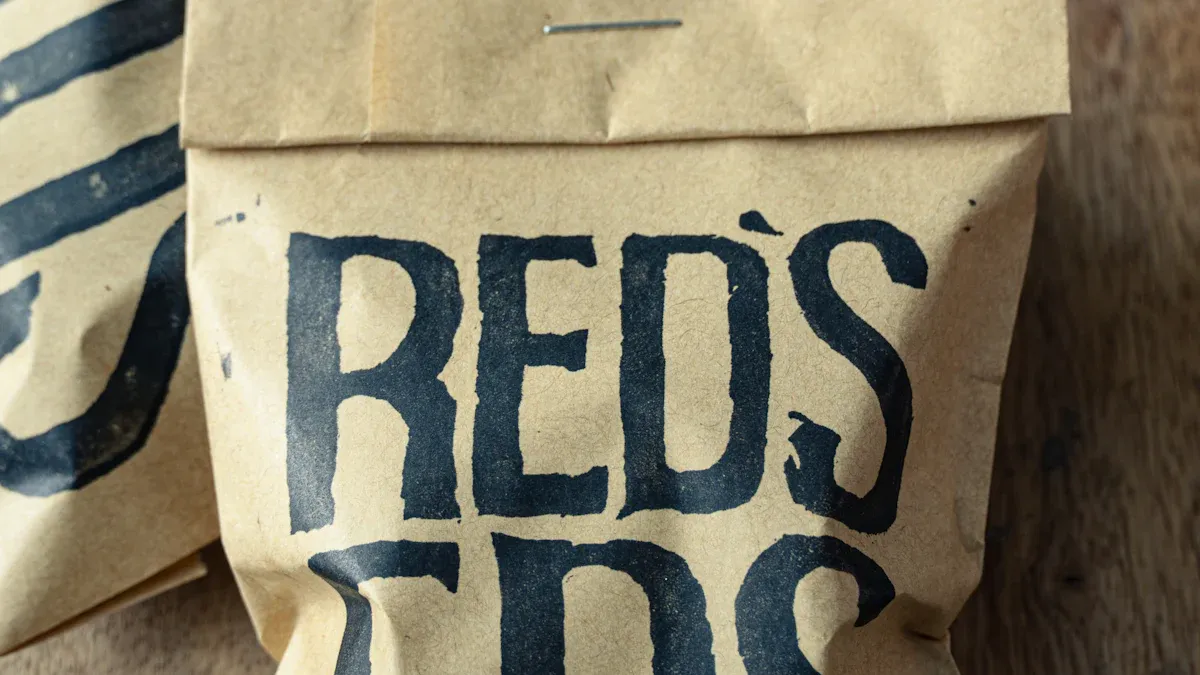
Paper bags give you the simplest entry point into sustainable fashion packaging. Sourcing certified paper bag & paper box packaging provides options that are widely recyclable, easy to print, and familiar to customers. You can choose the paper grade, the handle style, and the print method to match your brand. Each decision affects cost, look, and environmental impact.
Kraft, White, and Specialty Paper Options
Kraft paper is the workhorse of fashion retail bags. It offers strength, a natural look, and strong recycled content options. You can pick virgin kraft for maximum durability, recycled kraft for a lower footprint, or bleached kraft when your brand palette demands white or a custom color.
|
Paper Type |
Characteristics |
Cost per Bag |
Best Use |
|---|---|---|---|
|
Virgin kraft |
Stronger fibers, uniform natural brown color |
$0.18–0.28 |
Premium retail, maximum strength |
|
Recycled kraft |
Slightly weaker, possible color variation |
$0.15–0.24 |
Eco-conscious brands, standard retail |
|
Bleached kraft |
White/colored, treated fibers |
$0.22–0.35 |
Brand-specific aesthetics |
White paper bags cost more than natural kraft because the bleaching process adds steps. Expect white twisted-handle shopping bags to start around $0.49 per unit. White multi-wall bags with liners run higher, from about $0.55 to $0.71 per unit, depending on the construction.
Specialty paper can add texture, color and a premium tactile feel. It is useful for luxury retail brands, but it can increase cost and may require careful sample approval.
Specialty stocks suit boutique and luxury formats. Textured, coated, or colored papers create a tactile impression that plain kraft cannot match. Order samples first. Specialty paper often carries longer lead times and higher minimums.
Custom Printing and Branding Potential
Print turns a plain bag into a moving billboard. Your logo, colors, and message travel home with every customer. The print method you choose shapes visual quality, setup cost, and recyclability.
|
Printing Method |
Visual Quality |
Color Capability |
Setup Cost |
Ideal Volume |
Speed |
Surface Finish |
|---|---|---|---|---|---|---|
|
Flexographic |
Moderate (solid fill) |
Limited (spot colors) |
Low |
Large runs |
Very fast |
Matte, uncoated |
|
Offset |
High (fine detail) |
Full CMYK/Pantone |
High |
Medium–large runs |
Fast |
Glossy, matte, coated |
|
Screen |
Strong and bold |
1–3 colors |
Moderate |
Small–medium runs |
Moderate |
Textured, hand-feel |
|
Digital |
Excellent (photo-real) |
Full CMYK |
Very low |
Small runs, short lead |
Fast |
Smooth, variable data |
|
Hot Foil Stamping |
High-contrast, reflective |
Single-color foil |
Moderate–high |
Medium to high-end |
Slower |
Metallic, tactile shine |
|
Embossing/Debossing |
Sharp 3D relief |
No ink |
High |
Premium accents |
Slow |
Raised or recessed texture |
Match the method to your paper. Flexographic printing suits kraft bags because low-viscosity water- or soy-based inks apply efficiently on porous surfaces at low cost and high volume. Screen printing also works well for bold logos on kraft. Offset printing excels on coated and white cardboard bags, where it delivers sharp full-color graphics. Digital printing fits short runs and complex designs with minimal setup. Hot foil stamping and embossing add premium accents for boutique and luxury lines.
Ink choice matters as much as the press. Vegetable-based inks, soy-based inks, and water-based inks reduce toxic emissions and are easier to remove during recycling. Digital printing generates less waste because it needs no plates and supports on-demand runs. Minimalist designs with lower ink coverage further shrink the environmental footprint. Combine sustainable inks with smart print technology, and you cut the impact of every bag you ship.
Typical Cost Ranges per Unit
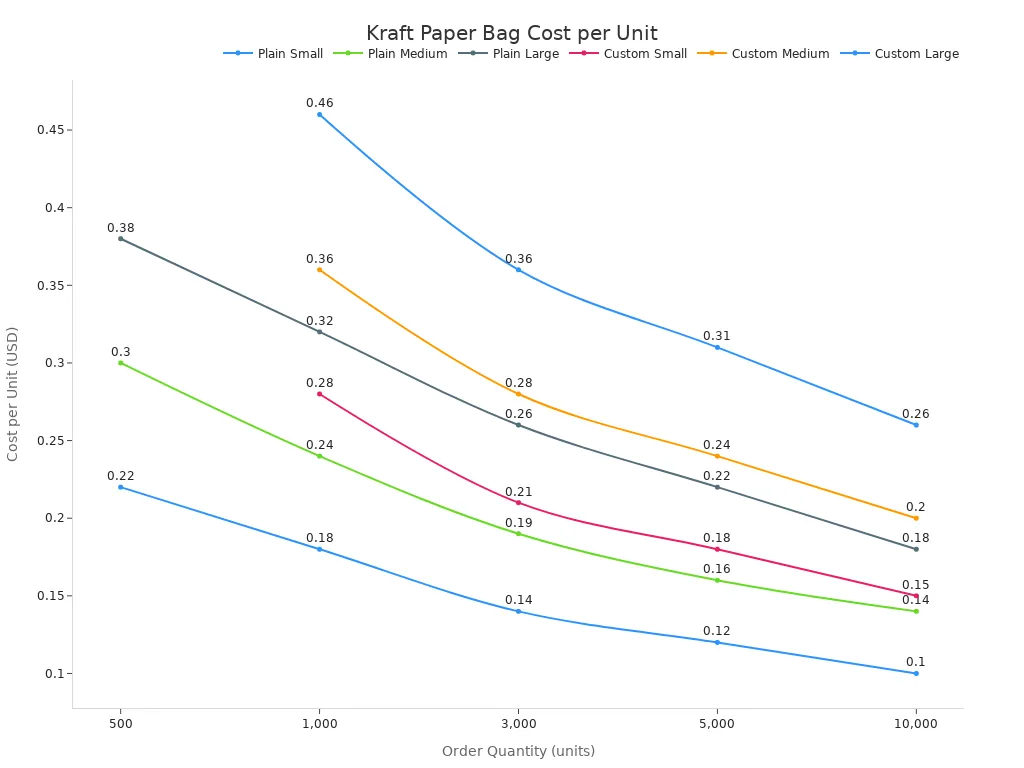
Paper bag pricing follows a simple rule: bigger orders cost less per unit. Size, paper grade, and print complexity also move the number. Plain kraft bags range from $0.10 to $0.38 per unit depending on size and quantity, with 5,000+ unit orders at the low end.
|
Order Quantity |
Small (22×10×28 cm) |
Medium (26×12×35 cm) |
Large (32×15×42 cm) |
|---|---|---|---|
|
500 units |
$0.22 |
$0.30 |
$0.38 |
|
1,000 units |
$0.18 |
$0.24 |
$0.32 |
|
3,000 units |
$0.14 |
$0.19 |
$0.26 |
|
5,000 units |
$0.12 |
$0.16 |
$0.22 |
|
10,000 units |
$0.10 |
$0.14 |
$0.18 |
Size drives the base price. Use this table to match bag dimensions to your product mix.
|
Size |
Dimensions (W×D×G) |
Typical Products |
Cost Range |
|---|---|---|---|
|
Extra Small |
18×8×22 cm |
Jewelry, cosmetics, small gifts |
$0.12–0.18 |
|
Small |
22×10×28 cm |
Clothing items, books, bakery |
$0.15–0.24 |
|
Medium |
26×12×35 cm |
Shoes, multiple clothing, takeout |
$0.18–0.30 |
|
Large |
32×15×42 cm |
Bulk shopping, large items |
$0.24–0.38 |
|
Extra Large |
40×18×48 cm |
Multiple purchases, wholesale |
$0.30–0.48 |
Custom printing adds cost, but the premium shrinks at volume. One-color flexographic printing adds $0.03–0.08 per bag plus a $600–1,800 setup fee. Totals land at $0.15–0.46 per bag for orders of 1,000–5,000 units. Full-color digital printing adds $0.08–0.15 per bag with a lower setup fee of $100–300.
|
Order Quantity |
Small |
Medium |
Large |
|---|---|---|---|
|
1,000 units |
$0.28 |
$0.36 |
$0.46 |
|
3,000 units |
$0.21 |
$0.28 |
$0.36 |
|
5,000 units |
$0.18 |
$0.24 |
$0.31 |
|
10,000 units |
$0.15 |
$0.20 |
$0.26 |
Bag format changes the math again. A printed twisted-handle kraft shopper runs $0.50–$1.60 per unit. You pay about $1.20–$1.60 at 250 pieces from online printers, and about $0.50–$0.90 at 1,000–5,000 pieces from promotional suppliers. A one-color SOS takeout bag costs $0.10–$0.60, with prices under $0.20 at 5,000+ units. Euro totes and ribbon-handle bags for boutique and luxury lines run $1.10–$5.00. The low end appears at 1,000 pieces with front-and-back print. The high end covers 50-piece runs and large sizes. "No minimum" design-your-own sites charge $1.60–$4.00 for 25–100 bags. That convenience suits a launch, but it gets expensive past the first order.
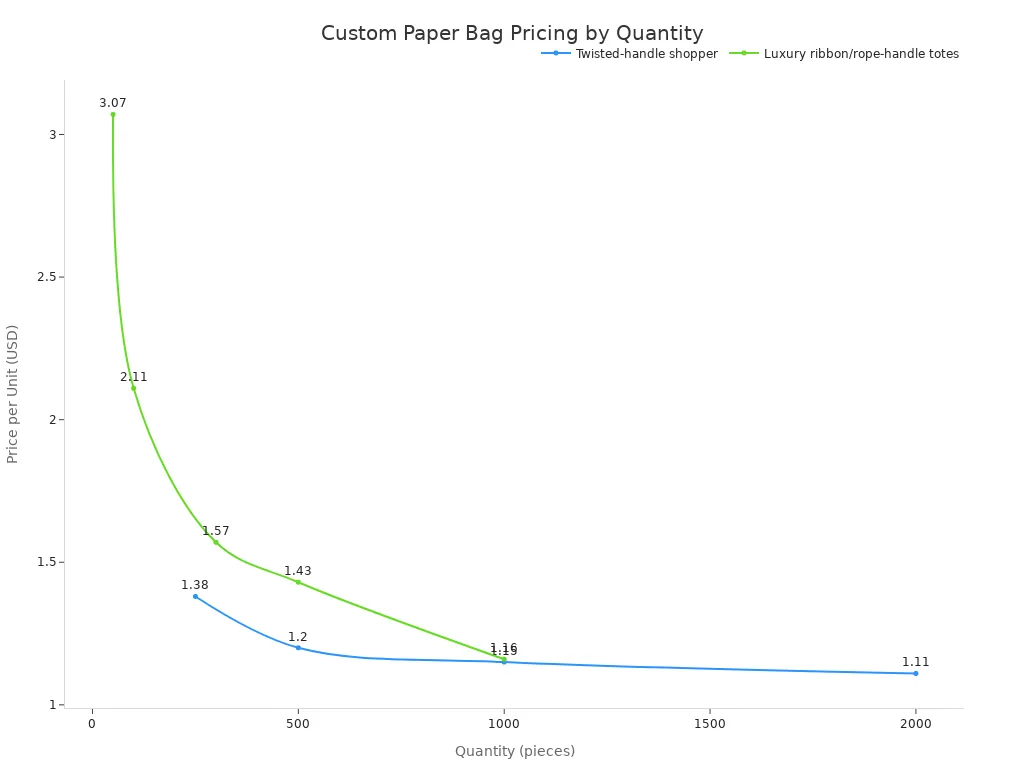
A live example makes the curve concrete. A twisted-handle shopper with one-color print costs about $1.38 per bag at 250 units, $1.20 at 500, $1.15 at 1,000, and $1.11 at 2,000. Luxury ribbon- and rope-handle totes start at 50 pieces: about $3.07 at 50, $2.11 at 100, $1.57 at 300, $1.43 at 500, and $1.16 at 1,000. Premium finishes such as hot foil stamping, embossing, and spot UV raise the unit price. They also push production runs to 5,000 units per design with 10–25 day bulk lead times.
Boxes: Shipping and Retail Packaging
Boxes carry your brand through two very different journeys. One box travels through a courier network and must survive drops, stacking, and weather. Another box sits on a retail shelf and must stop a shopper in her tracks. You need both types in a complete sustainable fashion packaging strategy, and each type follows its own rules for material, strength, and cost.
Corrugated vs. Folding Carton Boxes
Corrugated boxes and folding cartons look similar on the outside. Their construction tells a different story. A corrugated box uses multiple layers: a liner, a fluted medium, and another liner. That architecture creates air pockets that absorb impact and support heavy loads. A folding carton uses a single ply of paperboard. It holds its shape well, but it offers little load-bearing capacity. Choosing a sturdy custom paper box ensures high-end garments receive optimal protection without sacrificing the unboxing aesthetic.
|
Category |
Corrugated Box |
Folding Carton |
|---|---|---|
|
Structure |
Multi-layer (liner + fluted medium + liner) |
Single-ply paperboard |
|
Strength / Load-bearing |
High; built for stacking and heavy loads |
Low; holds shape but not load |
|
Transit Protection |
Resists impact, vibration, compression |
Minimal; not intended for shipping |
|
Print Quality |
Good, improving with modern presses |
Excellent; ideal for detailed branding |
|
Moisture Resistance |
Moderate to high |
Low; warps or weakens when exposed |
|
Cost |
Higher per unit but reduces breakage and returns |
Lower per unit; ideal for retail volume |
|
Sustainability |
Highly recyclable; high recycled content |
Recyclable, but coatings and foils reduce recovery |
|
Best Use |
Shipping, e-commerce, warehousing |
Shelf display, lightweight retail packaging |
"Using folding cartons for shipped items... Folding cartons aren't built for courier handling. Any product going through a shipping network needs corrugated boxes, and a carton box on a delivery truck has a short life expectancy."
That quote captures the core rule. Match the box to the journey. Folding cartons serve retail shelf presentation and branding. Corrugated boxes handle e-commerce shipping and protection. Break that rule, and you pay for it in damaged goods and unhappy customers.
Finishes follow the same logic. Folding cartons accept gloss or matte coating, foil stamping, and embossing. These finishes support premium fashion branding and shelf appeal. Corrugated boxes take kraft finishes, varnishes, coatings, and water-resistant treatments. These finishes serve function more than decoration. Folding cartons dominate cosmetics, food, pharma, and retail consumer goods. They suit lightweight, giftable fashion items. Corrugated boxes dominate e-commerce, shipping, industrial, and wholesale distribution. They suit the protective transit of fashion goods. On cost, folding cartons rank lowest and corrugated boxes sit in the mid-range. On sustainability, corrugated boxes rank as the most sustainable option, and folding cartons remain recyclable.
Recycled Content and FSC-Certified Board
Recycled content and certification turn a box from "recyclable" into "responsibly sourced." You should ask for both. Recycled content reduces demand for virgin fiber and lowers the carbon footprint of the board. FSC certification proves that any virgin fiber comes from responsibly managed forests. Together, they give you a defensible story for customers, auditors, and regulators.
Corrugated board already contains high recycled content in most markets. You can push that number higher by specifying a recycled liner and medium. Folding carton board offers similar options, though bright white grades often need virgin fiber for whiteness. Ask your supplier for the recycled percentage by weight, not by marketing claim. Request the FSC chain-of-custody code and verify it in the FSC database. A valid code proves the claim. A logo without a code proves nothing.
Watch the coatings. Gloss lamination, foil stamping, and plastic windows reduce recyclability because mills struggle to separate mixed materials. Choose water-based coatings, uncoated board, and paper windows when recovery matters. These choices keep the box inside the paper stream and protect your sustainability claims.
Cost Considerations for Low vs. High Volume
Box pricing rewards scale. Low-volume orders carry setup costs, small-run surcharges, and higher per-unit material prices. High-volume orders spread those costs across thousands of units and drop the per-unit price sharply.
|
Volume Tier |
Cost Range per Unit |
|---|---|
|
Low volume |
$1.50–$3.50 |
|
High volume |
$0.40–$1.80 |
A realistic working range for corrugated boxes lands at $0.75–$4.00 per unit. Small businesses shipping 100–500 orders per month typically pay $0.75–$2.50 per unit. The run size table shows how the curve behaves across larger programs.
|
Run Size |
Units |
Cost per Unit |
|---|---|---|
|
Short Run |
500–1,000 |
$2.75–$6.60 (total investment basis) |
|
Mid Run |
2,500–5,000 |
$2.75–$3.30 |
|
Mid-Large Run |
10,000–25,000 |
$1.38–$1.93 |
|
Large Run |
50,000–100,000 |
$1.21–$1.27 |
Short runs cost the most per unit because setup dominates the price. Mid runs bring the number down as tooling and setup spread across more boxes. Large runs deliver the best unit economics, but they demand accurate forecasts and secure storage. Over-ordering ties up cash and warehouse space. Under-ordering forces expensive reprints at short-run prices.
Custom printing adds another layer. One-color flexographic printing on corrugated board carries a modest setup fee and a small per-unit premium. Full-color digital printing suits short runs and complex designs with minimal setup. Premium finishes such as foil stamping and embossing raise the unit price and push minimum order quantities higher. Balance the branding gain against the volume penalty. A simple one-color logo often delivers more value per dollar than an elaborate finish on a low-volume run.
Eco Materials Beyond Paper
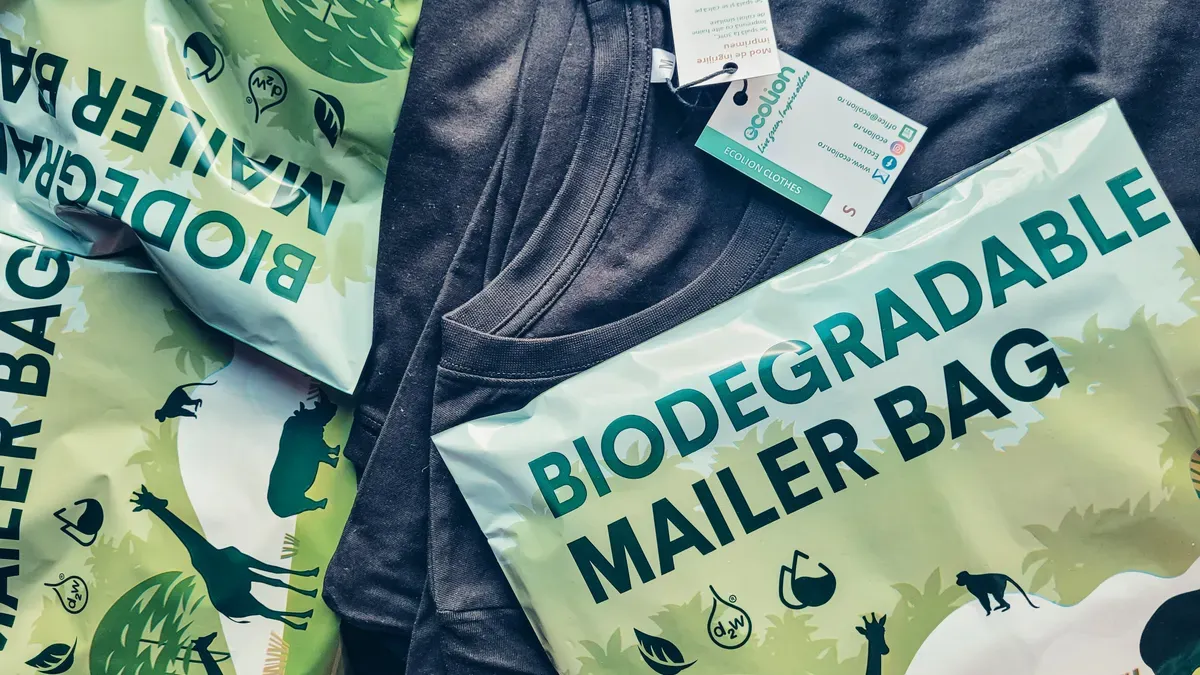
Paper covers most fashion packaging needs. Some brands need properties paper cannot deliver, such as water resistance or cushioning. Eco materials fill that gap. You can choose compostable fibers, recycled plastics, or reusable systems, and each option carries its own cost and performance profile.
Compostable and Biodegradable Options
Compostable materials break down under controlled conditions and carry third-party certification. Look for BPI in North America, TÜV Austria OK Compost internationally, or DIN CERTCO, which certifies to ASTM D6400 and EN 13432. These standards verify degradation rate, residue limits, and end-product safety. Common fashion options include cornstarch packaging, mushroom mycelium for fragile items, and acid-free tissue or kraft paper for wrapping garments. Biodegradable materials without certification carry no defined timeline, so treat the claim with caution.
Expect a premium. Compostable packaging costs roughly 20% to 30% more than conventional plastic, and certification runs $6,000 to $15,000 per product family. Plastic taxes in the UK, Spain, and France often exempt certified compostable formats, which offsets part of that gap.
Recycled Plastics and Reusable Packaging
Recycled plastics such as bio-PET and bio-PE match conventional plastic on strength and moisture resistance. They also plug into existing recycling streams, which keeps infrastructure costs low. Reusable systems, including durable mailers and returnable totes, carry higher upfront costs. They cut single-use waste and lower greenhouse gas emissions per delivered unit when customers participate in the return loop.
Material Comparison at a Glance
|
Material |
Cost |
Durability |
Environmental Impact |
|---|---|---|---|
|
Compostable fibers |
20–30% premium |
Strong, natural moisture resistance |
Renewable; needs industrial composting |
|
Biodegradable bioplastics |
High for algae; limited scale |
Comparable to plastic |
May still shed microplastics |
|
Recycled plastic |
Cost-efficient |
Same as conventional plastic |
Uses existing recycling streams |
|
Reusable systems |
High initial cost |
Built for many cycles |
Lowest waste per use |
Use this table to weigh sustainable fashion packaging options against your product mix and budget.
Benefits and Challenges of Going Sustainable
Environmental, Brand, and Compliance Benefits
Sustainable fashion packaging pays back on three fronts at once. Recycling and recovery cut energy demand by 24% and greenhouse gas emissions by 27%. Prevention benefits outweigh manufacturing and recovery emissions by five times.
|
Metric |
Quantified Value |
|---|---|
|
Energy demand reduction from recycling/recovery |
24% |
|
GHG emissions reduction from recycling/recovery |
27% |
|
GHG prevention benefits vs. manufacturing emissions |
5× greater |
Brand loyalty responds just as strongly. Consumers reward brands that act:
-
90% prefer brands with sustainable packaging
-
74% will pay more for it
-
39% have switched brands over unsustainable packaging
-
58% are more likely to recommend eco-friendly products
Track repeat purchase rate, Net Promoter Score, and reviews that mention packaging. These numbers prove the return to your finance team.
Supplier Vetting and Material Selection Hurdles
Vetting suppliers tests your diligence. Expect unverified claims, thin supply chain visibility, inconsistent suppliers, shifting regulations, internal resistance, and budget limits. Scrutiny separates real certifications from marketing language.
Vetting vendors requires scrutinizing their sustainability claims: checking whether recycled material meets industry standards and whether suppliers comply with local and international regulations. A thorough vetting process is what ensures transparency and credibility.
Educating Customers on Disposal
Customers need clear disposal instructions. Print sorting guidance on the bag or box. Label which components recycle and which compost. Simple icons beat long paragraphs. Clear guidance protects your claims and keeps materials out of landfill.
How to Choose the Right Packaging
Matching Packaging to Brand Goals and Budget
Start with your goals, not the catalog. Define what matters most: cost, carbon footprint, recyclability, branding, or fulfillment speed. Then weigh each option against those priorities.
-
Performance and protection: Match material strength to shipping distance and product fragility.
-
Certification verification: Ask for BPI compostable, FSC, or verified recycled-content proof.
-
Customer experience: Align the unboxing moment with your brand image.
-
Operational fit: Confirm automation-line compatibility, lead times, and quality testing.
-
Cost-benefit analysis: Balance upfront spend against waste savings and loyalty gains.
Your sustainable fashion packaging choices should reflect these trade-offs, not a single metric.
Questions to Ask Suppliers
Vet every supplier with direct questions. Ask which recycled stream they use, whether it is post-consumer or post-industrial, and how they verify recycled content. Request material declarations and test reports covering base material, coatings, inks, and adhesives. Confirm how they assess substances of concern. Clarify whether their evidence is general or order-specific. Finally, ask whether they can supply documentation in a format that supports your compliance records.
A Simple Implementation Roadmap
Follow a clear sequence to move from plan to practice.
-
Research regulations, consumer pressure, and waste infrastructure in your markets.
-
Audit your current packaging portfolio and baseline your recyclable, compostable, and recycled-content percentages.
-
Define scope by material, region, and packaging type.
-
Set targets for weight reduction, recycled content, and recyclability.
-
Secure leadership buy-in and communicate your ambition.
-
Build a resourced action plan with intermediate milestones.
-
Implement, report against your baseline, and refine as the landscape shifts.
Case Study and Expert Tips
How HOMER Helps Fashion Brands Switch to Sustainable Packaging
HOMER guides you through every stage of the switch. The team audits your current packaging, matches materials to your product needs, and sources certified kraft paper bag options, shipping boxes, and eco-friendly trims. HOMER also handles custom printing, so your branding stays sharp on recycled stock. You get one partner for supplier vetting, sample approval, and volume pricing. That single point of contact shortens lead times and removes guesswork from your sustainable fashion packaging plan.
Lessons from a Brand Transition
One fashion brand moved from plastic mailers to paper-based packaging and documented the hard-won lessons. You can apply these directly to your own rollout:
-
Manage inventory with shorter turns when you switch to paper-based materials.
-
Communicate proactively about water resistance concerns.
-
Address cost concerns early and budget for higher spend.
-
Support eco-friendly internal packaging, including poly bag alternatives.
-
Handle pushback from third-party logistics providers.
-
Match the customer's sustainability vision and keep communication open.
-
Monitor stock levels, plan storage space, and train fulfillment teams.
-
Conduct ship testing and adopt a gradual rollout.
-
Match materials to product needs and invest in reusable options.
-
Skip bioplastics where they do not fit your sustainability goals.
Expert Recommendations for First-Time Buyers
Start small and test before you scale. Order samples of each material, run ship tests, and gather customer feedback on the unboxing experience. Ask suppliers for certification codes and verify them yourself. Set a realistic budget that covers higher unit costs and new storage needs. Train your fulfillment team early. These steps protect your timeline and your brand reputation.
Treat sustainable fashion packaging as a strategic investment, not a cost center. Define your goals, compare materials and costs, vet suppliers, and educate customers. Start with one category, then scale up as you learn. HOMER supports every step of your transition.
FAQ
How much does sustainable fashion packaging cost?
Paper bags run $0.10–$0.38 per unit at volume. Boxes cost $0.40–$1.80 per unit in high volumes. Compostable materials add a 20–30% premium.
Which sustainable packaging material suits fashion brands best?
Paper bags and FSC-certified boxes fit most fashion needs. Choose compostable or recycled plastic options when you need moisture resistance or cushioning.
How do you start switching to sustainable packaging?
Audit your current packaging first. Order samples, run ship tests, and verify supplier certifications. Start with one category, then scale up as you learn.